
How can AI facilitate online shopping?
You’re torn between several products, your budget is tight and you have neither time nor inclination to compare different websites. Artificial intelligence can save you the trouble! Chatbots may advise you and help you find the product that meets your expectations or an exclusive promotional offer. But is an AI recommendation always the best one? How far can it guide you in the shopping process? What are the consequences if you let an AI place orders and pay on your behalf? European legislation is evolving to provide a better framework, but they cannot replace your own vigilance. Here are our tips for keeping AI-guided purchases under control.
In short
- AI speeds up product searches and comparisons, provided you phrase your query correctly.
- Its responses are a starting point, but in no way a guarantee of the product’s value and quality, the seller’s reliability or the legality of the purchase.
- If you delegate your purchases to AI, ask yourself who would be liable in the event of an error.
The use of AI has a significant environmental impact. If you want to shop online whilst minimising your carbon footprint, follow our tips!
How do you search for a product or service using AI?
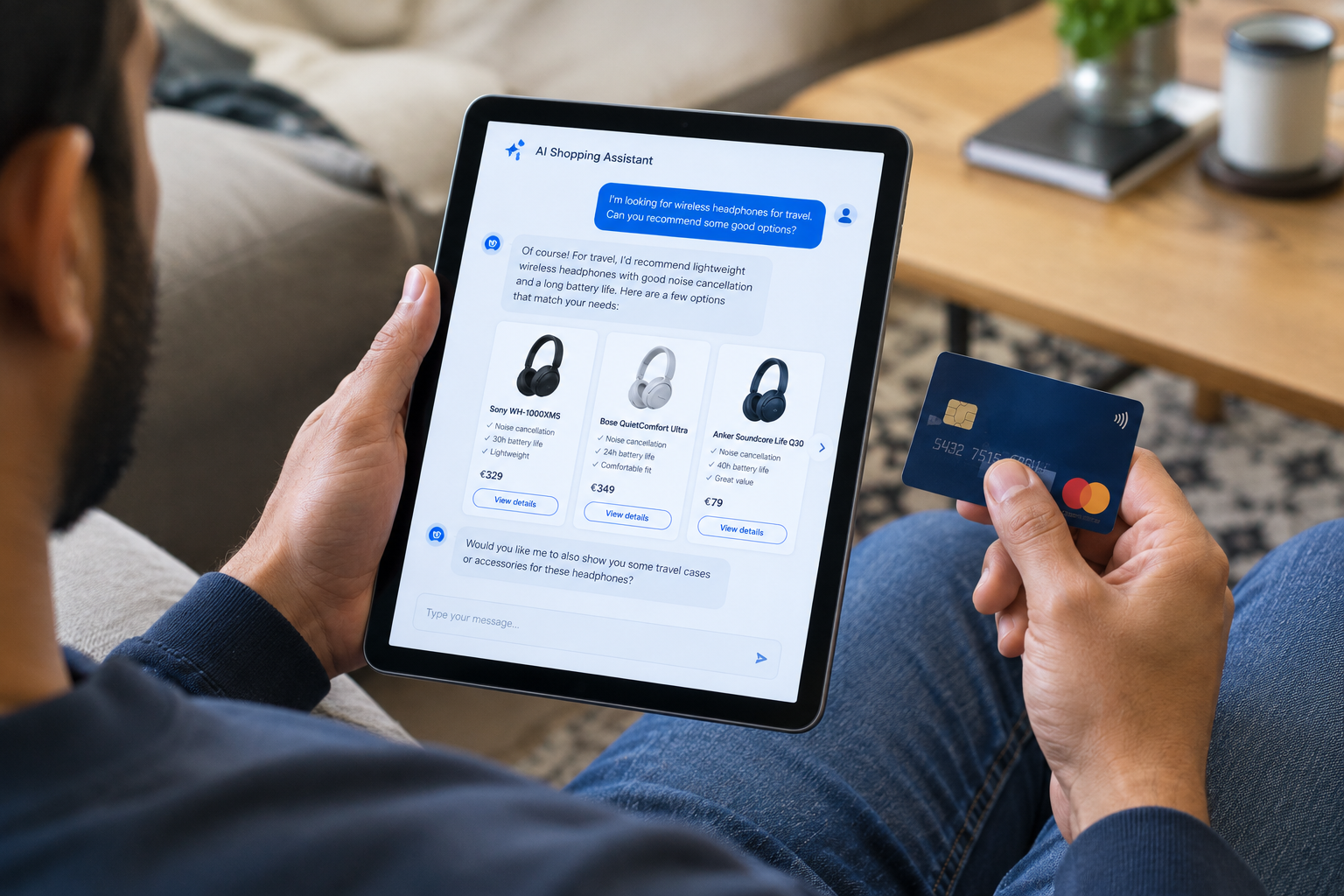
An AI chatbot or voice assistant works like an in-store advisor. You describe what you need and ask questions as if you were talking to a human, without having to limit your search to a string of keywords. This way of choosing what to buy may help you but also contains certain risks.
How can you find the perfect item in a matter of seconds?
AI agents let you compare several offers from different websites in the blink of an eye. Instead of visiting ten different websites, you can ask the tool to gather prices for the same product. You save a considerable amount of time, especially if you don’t know exactly where to look. Budget, intended use, constraints, preferences… You can specify your requirements and then refine your search as the conversation progresses.
But when you’re chatting with an AI agent, bear in mind that the quality of its response depends on the quality of your query.
That is why it is important to formulate your prompt (the instruction given to the AI) very precisely. Specify the country from which you are ordering, your budget and the intended use. Then ask explicitly what rules, restrictions or precautions apply to this type of product.
The quality and comprehensiveness of the responses can also vary greatly from one chatbot to another.
Check the AI’s recommendation
Whether you’re using a free or paid version, searching for a product via an AI agent offers no absolute guarantee.
Despite a precise prompt, some agents may direct you to dropshipping websites that aren’t always reliable, or even to fraudulent websites. It’s up to you to sort out which sellers are reliable and which are not.
Furthermore, the information AI provides may sometimes be inaccurate or out of date. AI can, in fact, ‘hallucinate’ and describe a product for sale differently than on the website. The price displayed may also be incorrect. In the end, the seller’s website remains the only official source of information that you should consult before making a payment.
The results provided by an AI agent are therefore a useful starting point, but they should ideally be supplemented by your own checks on the product or service on the seller’s website.
The electric scooter test
To simulate a search, ECC France gave the following prompt to several AI agents: “What are the average prices for a mid-range electric scooter capable of speeds over 30 km/h”. The responses varied considerably.
Some AIs suggested a model within the given budget, whilst reminding users of the 25 km/h speed limit on public roads in France – and sometimes in other European countries. Others, however, simply listed faster scooters without mentioning this restriction.
Depending on the situation, you therefore risk buying a product whose use is potentially illegal. A standard search engine would not necessarily have protected you any better. But you might expect an AI agent to inform you about the applicable rules and the precautions to take. However, depending on the tool and the wording of the query, this information may be missing.
Does AI always suggest the best deal?
Recommendations tailored to your profile
Depending on how it works, an AI agent may draw on your previous queries, your purchase history, your location, what you’ve said in your conversations, your account data, or the apps you’ve authorised it to access, to suggest a product or service to you.
A single query may seem innocuous. But by cross-referencing several requests, the AI learns a great deal more about you: your habits, your interests, and sometimes details of your personal life. Your profile can then be used to personalise recommendations, change the display order or tailor answers.
Some AIs may then personalise or sponsor advertisements. In such cases, the link in the ad must be accompanied by clear information. An AI agent may also suggest something other than what you were looking for, or a more expensive model from a higher-end range: this is known as upselling.
Keep in mind that an offer made by an AI does not therefore necessarily mean that it is the best offer for you. The result may well depend on the information used and cross-referenced by the AI agent, how it operates, or even any commercial or advertising links that influence the offers presented to you.
Beware of AI bias!
If the data that the AI analyses to provide you with a response contains errors or false information, the tool may reproduce or even amplify these in its recommendations. Let’s imagine that shoppers of a certain age range tend to choose a particular type of product more often. The AI system may end up systematically recommending it to people of that age. These people buy it more often, which reinforces the AI’s bias. Yet the product is not necessarily suitable for everyone.
Regulated personalisation in Europe
In the European Union, the Digital Markets Act (DMA) imposes specific rules on certain very large platforms. In several situations, they cannot combine your personal data from different services without your consent.
For instance, if you use a very large marketplace’s AI chatbot to buy a pair of headphones, that search and purchase cannot be automatically cross-referenced with your streaming or social media data. You must give your consent beforehand.
Personalised prices based on your data
Personalisation isn’t just about product recommendations. In some cases, it can also affect the price.
For example, if you have provided an AI agent with information about your financial situation, your assets or your savings, this data could – depending on how the service works – help to establish your consumer profile. If certain information is then passed on to a retailer or an online marketplace, it could be used to personalise the offer presented to you, or even the price quoted.
Be careful, however: not all AI agents work in this way. Price personalisation depends on the tool’s features, its connections to retail services and the information you have authorised to share. An agent may also simply search for a public price, which is the same for all consumers.
How can an AI agent access sellers’ prices?
An AI agent may be connected to a seller’s or marketplace’s IT systems, typically via an API (Application Programming Interface). Depending on the services offered, this connection allows it to access information about products, their availability and their prices.
The request sent to the seller may also include contextual details, such as your location, your customer account or your purchase history for instance. Then, the price obtained may be displayed directly in the conversation with the agent or shown to you on the seller’s website, where you can finalise your order.
What it means varies depending on the situation: the price may be public and the same for everyone, or it may be tailored to certain information available in your profile.
The best approach: to minimise the risk of personalised pricing, you can choose to search whilst not logged into your AI account.
Where the price of a product or service is personalised based on an automated decision, the trader must inform the consumer of this before the contract is concluded, in accordance with the European rules set out in Directive (EU) 2019/2161, known as ‘Omnibus’.
Price personalisation also exists without AI
AI agents are not the only tools that can be used for personalised pricing. A retailer or marketplace may also use data linked to your customer account, your location, your browsing history or your device, particularly via cookies and other trackers.
Our advice on using AI before making a purchase
AI can make it easier to search for a product or compare offers. However, the results provided are not necessarily comprehensive and do not always represent the best deal for you.
Before placing an order:
- Refine your query in the AI tool. Specify your budget, intended use and country, then ask what legal requirements or precautions apply.
- Use the AI as a starting point. Treat its responses as a research aid, not as a definitive answer. Ask the same question using a different tool or a comparison website.
- Compare the results provided by the AI with the offers on the seller’s website and other online retailers. Check the specifications and price before paying.
- Limit the personal information you provide to the AI. Avoid sharing sensitive data or financial information that is not necessary for your search.
- Spot the adverts. A sponsored link must be identified as such. Be wary of suggestions that stray from your original query.
- Question the recommendations. Why is this product being suggested to you? Does it meet your needs or fit your budget? Are there cheaper alternatives
- Assess the seller. Find out more about the reliability of the seller and the reviews left by other buyers.

AI influencers: who really influences your purchases?
Do you follow influencers on social media? Behind some accounts may lie a persona that doesn’t exist in real life. Created or powered by artificial intelligence, these virtual influencers can also recommend products and encourage you to buy them.
When AI tries to persuade you
Interactions with a virtual influencer can be designed to adapt to their audience’s reactions and interests. Certain systems can thus personalise their messages, nurture a relationship with their followers or play on their emotions to encourage them to buy a product or service.
The line between advertising, advice and personal interaction then becomes harder to discern. In fact, the character may seem close to you, share your concerns or present themselves as someone you can trust, whilst their primary objective is commercial.
It is particularly important to be vigilant when it comes to minors. A virtual character may be perceived by children and teenagers as a friend or role model, without young followers always understanding the commercial interests behind their recommendations.
Who is liable if the virtual influencer misleads you?
Transparency is essential: consumers must be able to understand who they are dealing with and identify the commercial interests at stake.
Since 2 August 2026, certain transparency obligations set out in the European regulation on artificial intelligence, known as the ‘AI Act’, have come into force. These relate to providing information to people who interact with certain AI systems and to the disclosure of certain content generated or manipulated by AI, notably deepfakes. However, they do not require a virtual influencer to be systematically identified as artificial. Other rules relating to advertising and commercial practices may also apply.
In the event of a misleading recommendation, the promotion of a dangerous product or an unlawful commercial practice, the virtual nature of the character must not prevent the identification of those responsible. Consumers must be able to trace the individuals or companies that create, control or commercially exploit the influencer, and have simple means of reporting problematic content. You can submit a report via SignalConso.
In a near future, will AI become your personal shopper?
Today, AI helps you search for and compare products and offers you advice. Tomorrow, it could make purchases, book a trip, manage or cancel a subscription, from start to finish without your involvement. You would provide your criteria and budget, and it would take care of the rest, from searching to payment. This is known as agentic commerce or agent-based shopping.
The more the AI acts on your behalf, the more questions you need to ask yourself:
- To what extent do you want to delegate your decisions, and who is responsible if the AI makes a mistake?
- How can you ensure that it is acting in your best interests and not in those of the company that pays it?
- What level of transparency are you entitled to regarding the offers, the criteria used and the decisions made?
- How can you understand, monitor and reverse its actions?
An example: delegating travel bookings to an intelligent algorithm
You ask an agent to organise a trip to Spain within a specific budget and set criteria. They book the flight and the hotel, then pay for them. But you later find out that the flight has been cancelled by the airline. The hotel booking is no longer needed, but you cannot cancel or change it without incurring a fee. Who is responsible?
Today, for a package holiday, European regulations protect the traveller. The organiser is responsible for the proper performance of the services included in the package. But if an AI agent organised the trip, could the company operating it be held liable? Or should we consider that the AI merely made, on your behalf, two separate bookings with two different service providers? These questions remain unanswered for the time being.
This is no longer science fiction. First trials have begun in France and across Europe and beyond. Payment providers are experimenting with systems that allow AI agents to initiate purchases and make payments on behalf of consumers. The transaction is carried out end-to-end, without human intervention.
This aims at simplifying certain everyday tasks, whilst maintaining consent and security controls. But these experiments raise a fundamental question. If we entrust AI with searching, choosing and paying, how do we retain control over our purchases?
You may also be interested in
Funded by the European Union. Views and opinions expressed are however those of the author(s) only and do not necessarily reflect those of the European Union or the European Innovation Council and Small and Medium-sized Enterprises Executive Agency (EISMEA). Neither the European Union nor the granting authority can be held responsible for them.
Was this article helpful?

